
The world generates more than 2 billion tonnes of municipal solid waste (MSW) every year — and the World Bank projects that figure will grow to roughly 3.4 billion tonnes by 2050. Landfills are running out of space, disposal costs keep climbing, and regulators are pushing cities to divert waste from the ground and put it to use.
One of the most practical solutions is Refuse Derived Fuel (RDF) — a solid fuel made from the combustible fraction of household waste. In this guide, we break down the full journey of turning MSW into RDF, step by step.
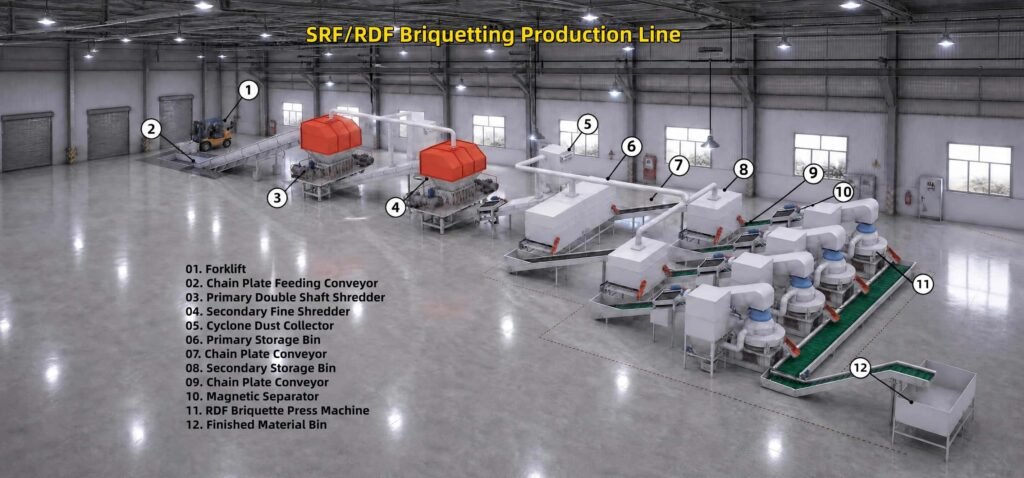
What Is RDF Fuel?
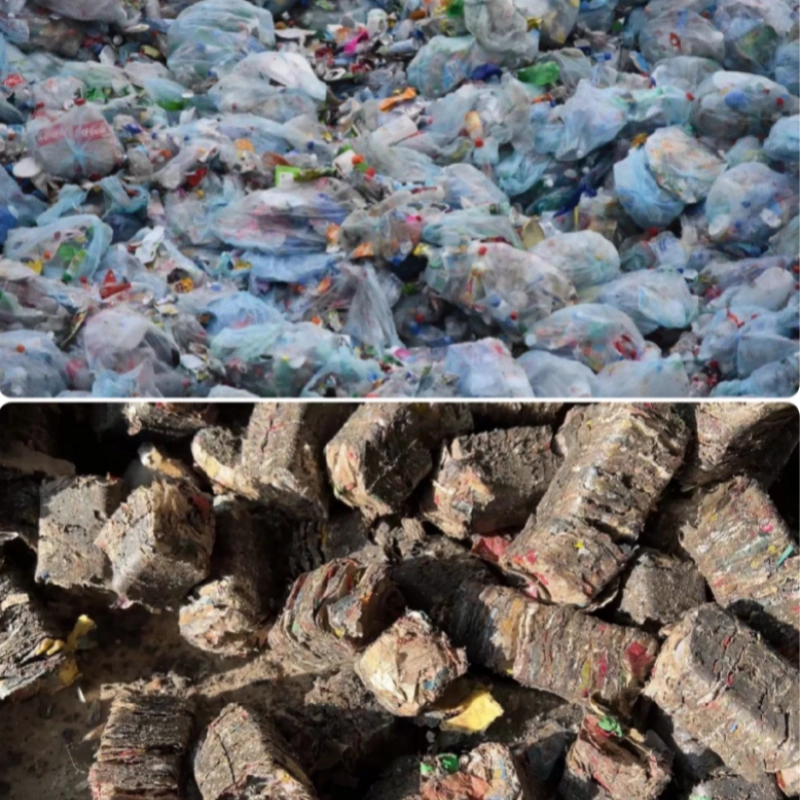
RDF (Refuse Derived Fuel) is a solid biofuel produced from the non-biodegradable part of municipal solid waste. After sorting out organics, inerts and metals, the remaining fraction — mostly plastics, paper, textiles and other combustibles — is shredded, dried and briquetted into a uniform solid fuel.
A well-produced RDF typically offers:
- Calorific value of 15–20 MJ/kg (3,600–4,800 kcal/kg) — 2–3 times higher than raw MSW
- Moisture content below 30%, with quality lines targeting below 25%
- Stable combustion, easy transport and storage
- One tonne of RDF can replace about 0.7 tonnes of standard coal and reduce CO₂ emissions by about 2.77 tonnes
For waste management companies, cement plants and energy producers, RDF turns a disposal cost into a saleable fuel product.
The 5 Stages of the RDF Conversion Process
Stage 1 — Sorting and Pre-treatment
MSW arrives at the plant on conveyors or by direct tipping. The goal of the first stage is simple: keep the combustibles, remove everything else.
A typical sorting line combines:
- Manual sorting belt to remove large items and hazardous materials
- Trommel screen to separate size fractions
- Magnetic separator and eddy-current separator to recover ferrous and non-ferrous metals (recovery rates of 95–98% are achievable)
- Air classifier (optional) to remove fine inerts such as glass, sand and ceramics
Removing inerts and metals at this stage protects the shredder blades and dramatically improves the final fuel’s calorific value.
Stage 2 — Shredding
Sorted waste is fed into a low-speed, high-torque twin-shaft shredder, which cuts it into uniform chips of 50–150 mm.
Why low-speed, high-torque? Compared with high-speed hammers:
- Finer, more uniform output with less dust and noise
- Lower blade wear and easier maintenance
- Better handling of plastics, rubber, e-waste and other tough materials
- Safer operation, with no need for frequent blade replacement
Stage 3 — Drying
Freshly shredded waste can still carry 40–60% moisture. A rotating drum dryer (heated by natural gas, biomass, or recovered heat) brings the moisture down to the target level, usually below 25–30%.
Drying is the stage that most directly determines the calorific value of the final fuel — the lower the moisture, the higher the energy density.
Stage 4 — Briquetting
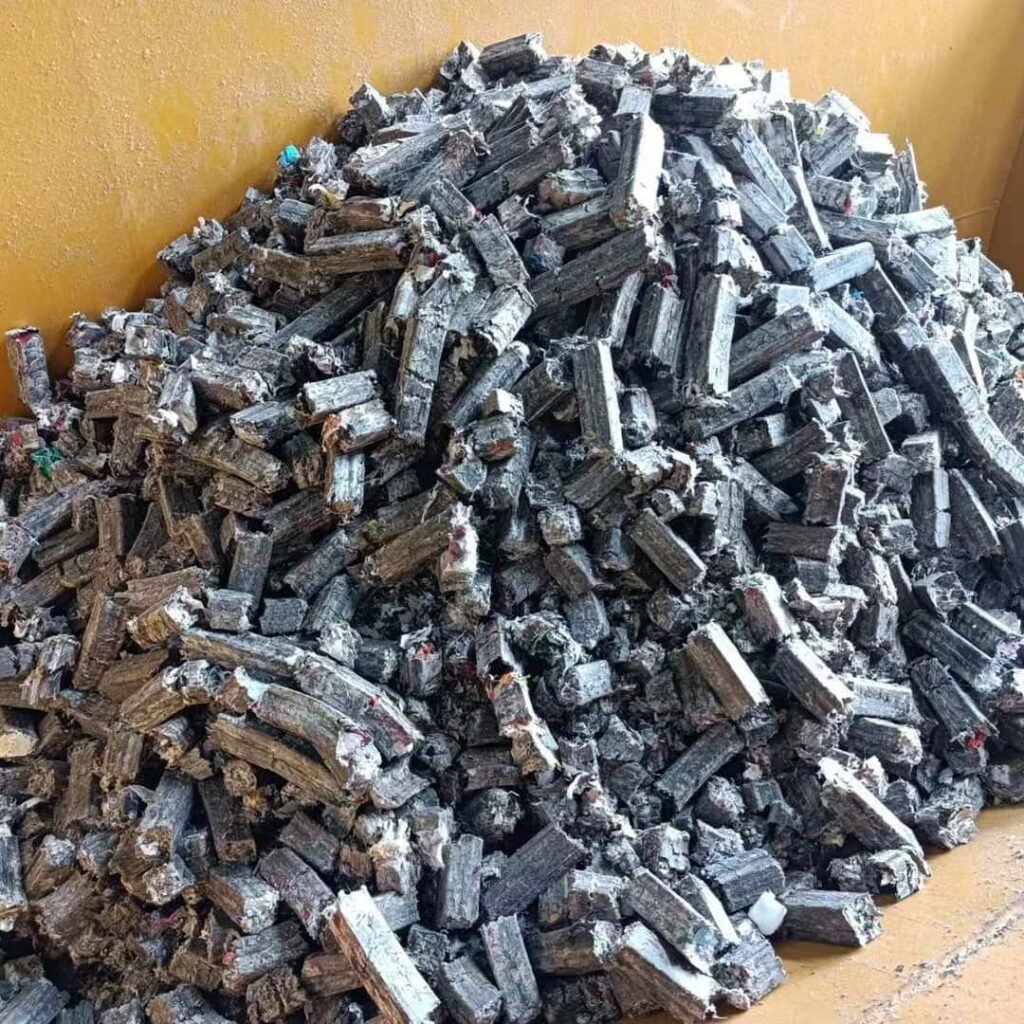
The dried, shredded material is fed into an RDF briquetting machine (hydraulic or mechanical press), which compresses it into dense fuel briquettes, typically 30–60 mm in diameter (diameter and length customizable per the downstream furnace requirement) — usually without any chemical binder.
This is a different technology from biomass pelleting: pellet mills (flat-die or ring-die) produce small 6–12 mm pellets and demand very dry, fine feedstock. MSW-based RDF is wetter and coarser, so a press forming larger briquettes is the right tool.
Briquettes are far easier to handle than loose chips:
- High density — more energy per unit of transport and storage
- Stable shape and calorific value from batch to batch
- Easy to palletize, stack, store and ship
- Reliable, consistent combustion in cement kilns and industrial boilers
Stage 5 — Quality Control, Packaging and Storage
Before the fuel leaves the plant, samples are tested in the lab:
- Calorific value (bomb calorimeter)
- Moisture, ash content
- Chlorine and other trace elements — important for cement kilns, where high chlorine content can damage the process
- Particle size and density
Qualified product is then bagged (typically 1-tonne jumbo bags) or loaded into bulk storage for dispatch to the customer.
Key RDF Quality Parameters at a Glance
| Parameter | Typical target | Why it matters |
|---|---|---|
| Calorific value | 15–20 MJ/kg (3,600–4,800 kcal/kg) | Determines how much coal the fuel can replace |
| Moisture | < 30%, best < 25% | Combustion stability and transport cost |
| Ash content | < 15–20% | Protects furnace and kiln |
| Chlorine | Commonly targeted < 1–2% | Prevents corrosion in cement co-processing |
Your exact targets depend on the fuel specification of the downstream customer — cement plants and power plants each have their own requirements.
Where Is RDF Actually Used?
- Cement kilns — the largest market; RDF replaces fossil fuel in co-processing
- Waste-to-energy power plants — RDF as a primary or supplementary fuel
- Industrial boilers — brick, glass, lime and other energy-intensive industries
How to Choose the Right RDF Production Line
Before investing in a line, answer four questions:
- How much waste do you have per day? Capacity (5 to 100+ tonnes per day) should match your secured waste supply.
- What is the composition of your feedstock? Plastic-heavy waste calls for different shredding and screening than wet, food-heavy waste.
- What does your customer’s furnace require? Cement kilns, power plants and industrial boilers have different specs for calorific value, moisture, particle size and chlorine.
- How automated should the line be? Higher automation means lower labor cost but a higher upfront investment.
A good supplier will design the line around your specific feedstock and fuel target — not just sell you a standard package.
Conclusion
Converting municipal solid waste into RDF is no longer a pilot concept — it is a proven, bankable business model in Europe, the Middle East, Southeast Asia and beyond. The core of a successful plant is the same everywhere: thorough sorting, reliable shredding, effective drying and consistent briquetting, followed by strict quality control.
If you are planning an RDF project and want a line sized to your waste volume and your customer’s fuel specification, talk to our engineers — share your daily tonnage and target specs, and we will help you design the right production line.