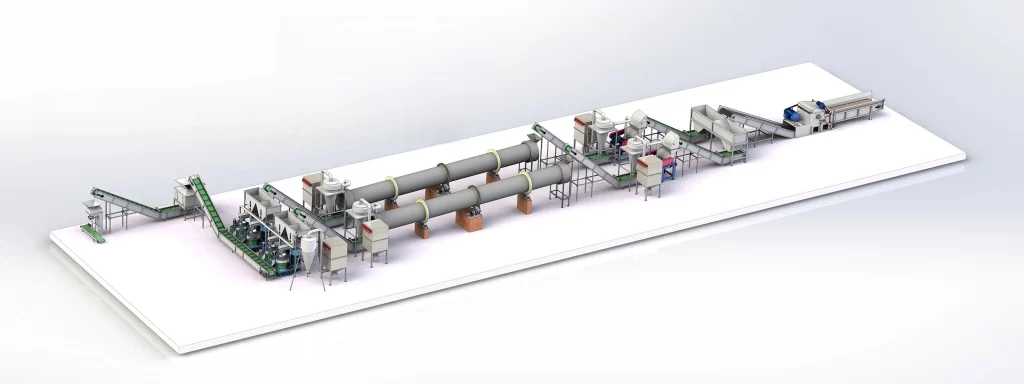
A high-quality wood pellet starts long before it enters the pellet mill — it starts at the crusher. If your wood crusher is too small, too weak, or matched to the wrong raw material, every stage downstream pays the price: low throughput, blocked dies, dusty and crumbly pellets, and faster wear on the most expensive machine in your line.
Choosing the right wood crusher is not about buying the biggest machine you can afford. It is about matching raw material, particle size, capacity, and working conditions to your specific pellet production goals. This guide walks you through every factor that matters, so you can configure a crushing line that actually supports your pellet mill instead of limiting it.
1. Why the Wood Crusher Determines Your Pellet Quality
A pellet mill does not compress logs, branches, or wood chips. It compresses sawdust. Inside the pellet mill, rollers force finely ground material through the small holes of a ring die or flat die — most commonly 6 mm or 8 mm for fuel pellets.
If the particles entering the die are too large, three problems happen:
Blocked die holes — oversized fibers bridge across the holes instead of passing through.
Poor pellet formation — particles cannot interlock tightly, so pellets crack, break, or produce excess dust.
Faster die and roller wear — the machine works harder to compress uneven material, shortening the life of its most expensive spare parts.
For most small and medium operations, size reduction happens in two stages: chipping (logs into 20–30 mm chips) and grinding (chips into 3–5 mm sawdust). A comprehensive wood crusher combines both stages in one machine, which is why it is so popular for small and farm-scale pellet plants.
2. Start With Your Raw Material
There is no single “best wood crusher” — there is only the best crusher for the material you actually have. Before comparing models, list the type, size, and condition of the wood you will process most often.
Your Raw Material
Recommended Machine
Logs and round timber (large diameter)
Drum chipper, disc chipper, or comprehensive wood crusher
Branches, twigs, pruning waste
Comprehensive wood crusher (cuts and grinds in one pass)
Wood chips, slabs, edge trimmings
Hammer mill / sawdust machine
Pallets, demolition wood, nailed wood
Wood shredder + hammer mill (nail removal)
Ready sawdust or shavings
No crusher needed — go straight to drying
Crop straw, husks, stalks
Straw crusher / hammer mill
A common mistake is buying a machine built for clean logs when most of your material is mixed branches with leaves and bark, or buying a standard crusher for waste pallets that contain nails and metal.
3. The Main Types of Wood Crushers for Pellet Production
Understanding the machine categories will help you avoid oversizing or under-equipping your line.
Disc wood chipper — uses a rotating flywheel with knives. Produces very uniform chips and handles large-diameter logs well.
Drum wood chipper — a rotating drum with blades offers high throughput and tolerates mixed wood sizes better. Usually the first stage in medium and large lines.
Hammer mill (sawdust crusher) — beats chips through screens with hammers. It produces the final 3–5 mm sawdust the pellet mill needs.
Comprehensive wood crusher — integrates knife cutting and hammer grinding. It takes logs and branches directly to sawdust in one pass, saving space, labor, and investment for small producers.
Double-shaft wood shredder — handles bulky, contaminated, or nailed wood such as pallets and demolition waste, but its output needs a second grinding stage.
Mobile / track-mounted crusher — the same crushing capability on wheels or tracks, ideal when material is spread across multiple sites or collection points.
4. Match the Output Size to Your Pellet Mill
A practical rule in pellet production: the final sawdust particle should be no larger than one-third of the die-hole diameter.
6 mm die → sawdust around 2–4 mm
8 mm die → sawdust around 3–5 mm
The screen inside your hammer mill or comprehensive crusher controls this size. Smaller screens give finer sawdust but lower throughput, so choose the screen size based on your die diameter rather than “the finest possible.”
Also aim for a controlled mix: roughly 80% fine particles with 20% slightly coarser material often pellets better than 100% powder, because coarser fibers create structure inside the pellet.
5. Match the Capacity — Avoid the Number-One Bottleneck
The crusher must out-produce the pellet mill. Why? Because crushing does not run every minute of the day: raw material moisture varies, knives need sharpening, screens need changing, and feeding is never perfectly continuous.
A safe target is a crushing capacity of 1.2 to 1.5 times your pellet mill capacity:
In a two-stage line, size the hammer mill to match the pellet mill closely, and size the chipper to keep the hammer mill continuously fed. Never use a machine’s maximum theoretical throughput as its real working capacity — real-world output with fresh, wet wood is usually lower.
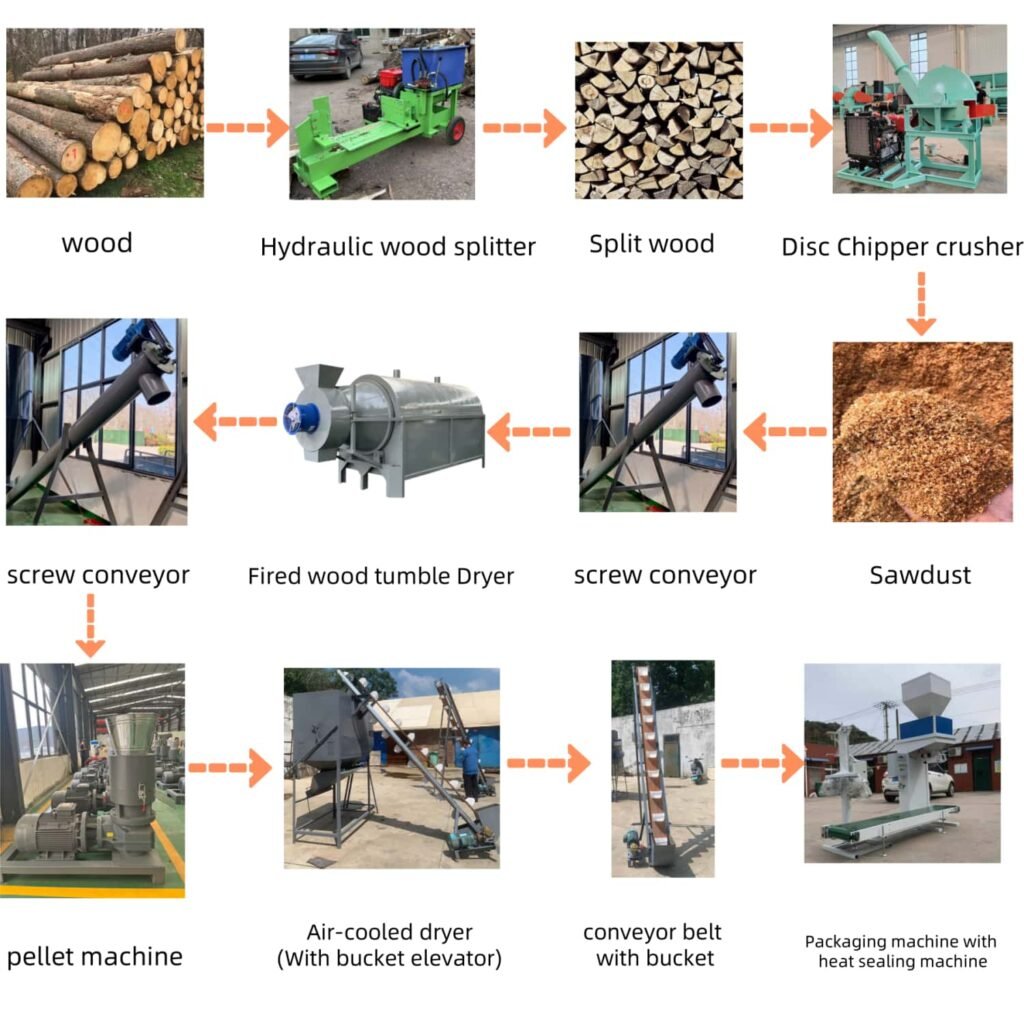
Full processing flow from raw logs to finished packed wood pellets
6. Moisture, Power Source, and Mobility
Three practical factors often get overlooked until the machine arrives on site.
Moisture. The ideal moisture for pelleting is 12%–15%. Freshly cut wood can hold 40%–55% moisture, so a dryer is part of almost every line. Your crusher works fine with wet wood, but remember: wet material is heavier, which lowers the dry throughput of the machine.
Power source. Electric motors (380 V, three-phase) are standard for fixed plants and cost less to run. Diesel engines are the only realistic choice where three-phase power is unavailable or unreliable. If you export or operate in regions with unstable grids, check the local voltage and frequency before ordering.
Mobility. A stationary line costs less and is more efficient for a fixed workshop. A mobile or track-mounted comprehensive crusher is worth the premium when you process material at farms, orchards, or collection yards instead of a single site.
7. Recommended Setups by Production Scale
Farm / family workshop (up to 300 kg/h): One comprehensive wood crusher + one small pellet mill (flat die or small ring die). One machine turns branches and logs into sawdust; one operator can run the whole line.
Small commercial plant (500–800 kg/h): Drum chipper or comprehensive crusher + hammer mill + ring die pellet mill + dryer + cooler. Two-stage size reduction gives stable sawdust quality and protects the ring die.
Waste recycling / pallet business: Double-shaft shredder (with metal separation) + hammer mill + ring die line. This is the only configuration that handles nails and contaminated wood safely.
8. A 5-Point Checklist Before You Order
Do I know my exact raw material — type, maximum diameter, and whether it contains metal?
Will the final sawdust match my pellet mill die size (about one-third of the hole diameter)?
Is the effective crushing capacity 1.2–1.5 times my pellet mill capacity?
Is three-phase power available, or do I need a diesel-driven model?
Will the wood come to my workshop, or do I need a mobile machine?
Conclusion
The right wood crusher is the one that delivers a continuous supply of correctly sized sawdust to your pellet mill. Match the machine to your raw material, control the final particle size through the right screen, and oversize your crushing stage slightly so it never becomes the bottleneck. Get these three things right, and your pellet mill will run smoother, last longer, and produce the firm, low-dust pellets that buyers reorder.
If you tell us your raw material type, target pellet capacity, and local power conditions, we can recommend a complete crushing-and-pelleting configuration with a matching quotation.