Biomass pellet manufacturing is a sequential process governed by consistent feedstock granulometry. A common engineering mistake among new project developers is assuming pellet mills can directly ingest oversized feedstock such as round logs, thick pruning branches, discarded wooden pallets and construction formwork. The pellet press is designed for fine sawdust of controlled particle distribution; direct feeding of bulky wood will trigger motor overload, accelerated die and roller abrasion, frequent blockage and unstable pellet quality. Therefore, the comprehensive wood crusher functions as the critical upstream size reduction station, forming the first process node of a standardized biomass pellet plant.
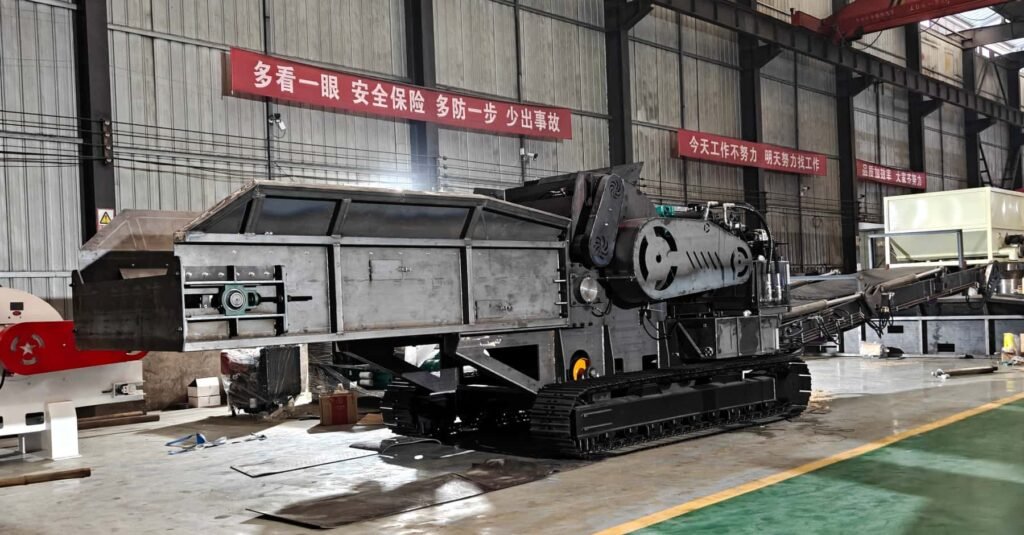
Beyond supporting pellet production workflows, this versatile wood reduction machine is not limited to pellet plant deployment. An optional tracked undercarriage can be integrated into the unit, turning it into a self-propelled mobile crusher. The tracked configuration eliminates reliance on fixed foundations and external towing equipment. Operators can drive the machine directly to forest yards, roadside pruning sites, demolition yards, farmland edges and decentralized biomass collection points. On-site crushing cuts down the high logistics cost of hauling bulky raw timber, which brings remarkable economic advantages for scattered biomass resources.
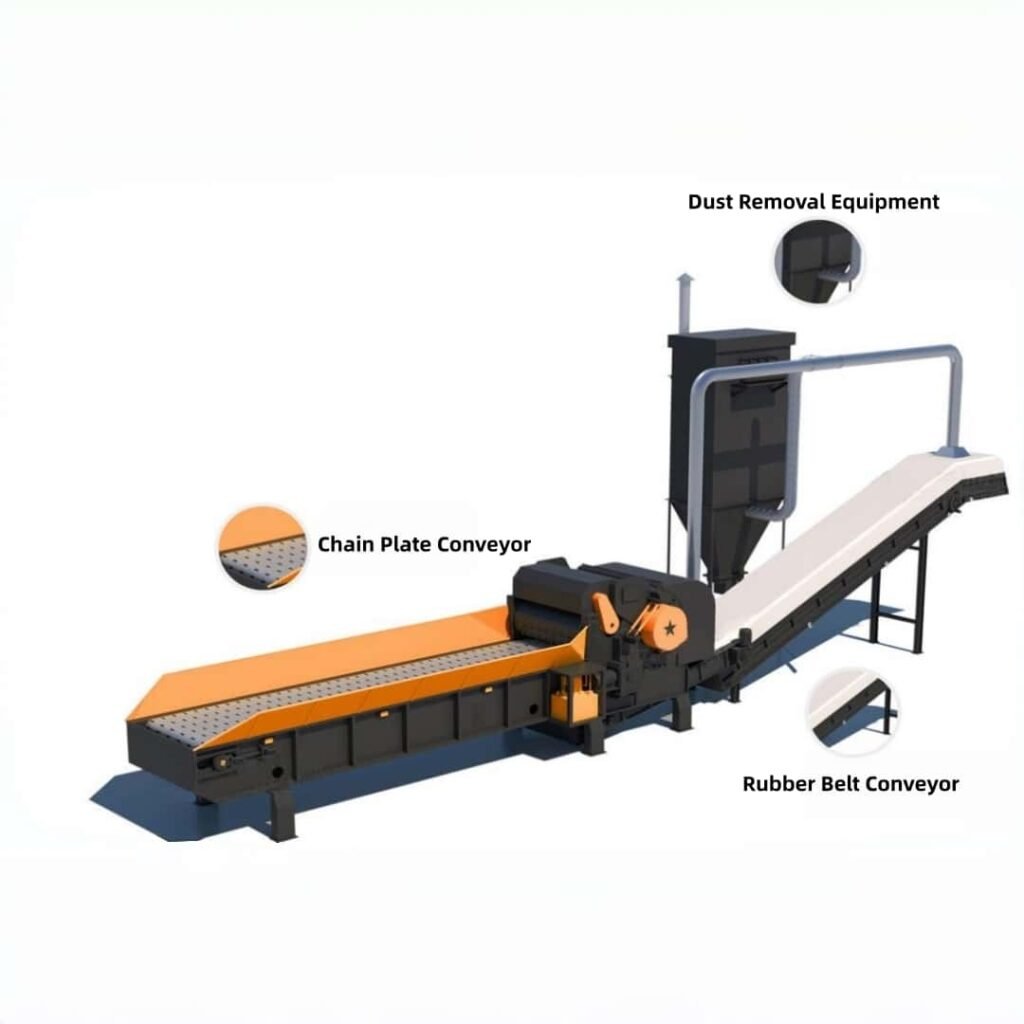
This integrated wood reduction equipment combines chipping and primary crushing in a single chassis. It accepts large-format incoming material and reduces it into homogeneous coarse wood chips, which are conveyed downstream to secondary fine grinding equipment, typically a water drop hammer mill, to produce sawdust qualified for pelletizing. Stable granulometry from the front-end crusher homogenizes the load on the hammer mill, mitigates pulsating feeding, optimizes the drying regime, and lays a prerequisite foundation for consistent pellet bulk density, compressive strength and low fines content. Uniform coarse fraction also reduces dynamic fatigue on downstream rotating assemblies and extends the service cycle of consumable parts across the whole line. Besides pelletizing, the discharged chips are also suitable for biochar production, boiler fuel, composting and board raw material preparation.
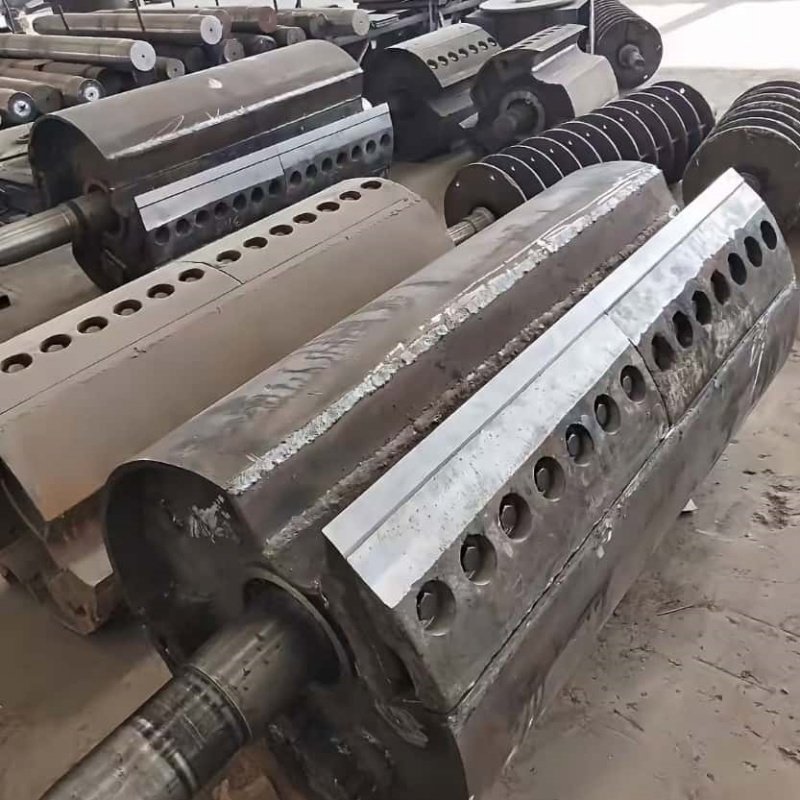
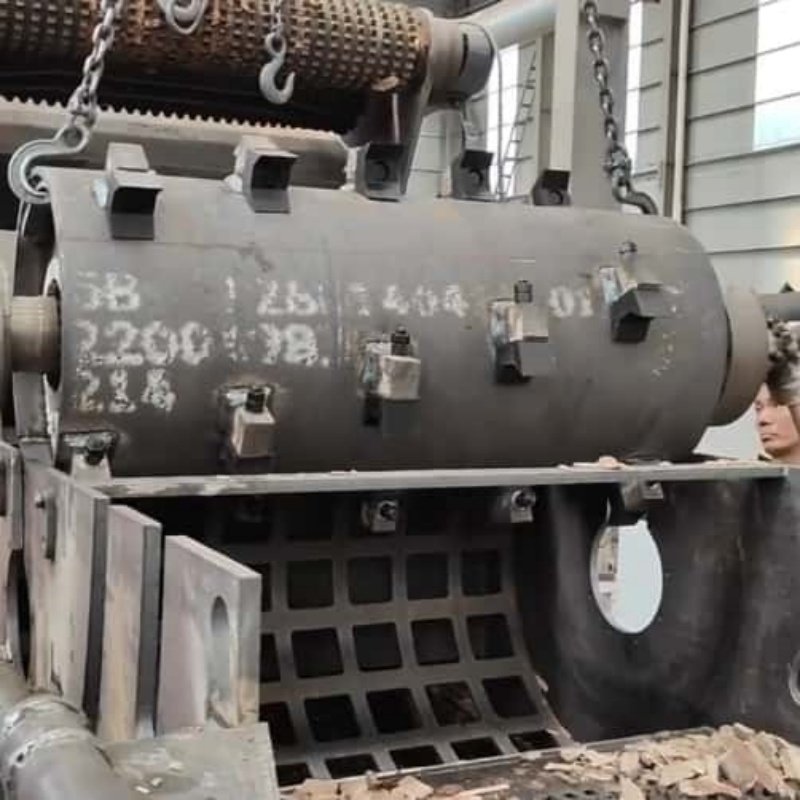
The machine is configured for diversified lignocellulosic feedstock: fresh hardwood & softwood logs, tree branches, wood slabs, sawmill trim ends, waste pallets, formwork, wood offcuts and clean wood residues. The standard configuration includes an automatic chain plate feeding system linked with main motor load feedback. The control loop modulates feeding velocity dynamically to prevent cavity congestion and no-load cycling. The heavy-duty balanced rotor assembly adopts alloy wear-resistant cutting tools, engineered for continuous 24-hour heavy-duty operation under abrasive wood processing conditions. The tracked version adopts heavy-duty rubber tracks, adapting to muddy, uneven and rough terrain; the hydraulic travel system supports stable forward, reverse and steering control.
We offer a portfolio of capacity models matched to small, medium and large-scale pelletization facilities. Drive options include electric motor and diesel power package for off-grid sites. Customization is available for inlet dimension, discharge particle grading, conveyor matching, skid-mounted layout or tracked mobile chassis according to feedstock characteristics, target throughput, workshop civil layout and field working conditions.
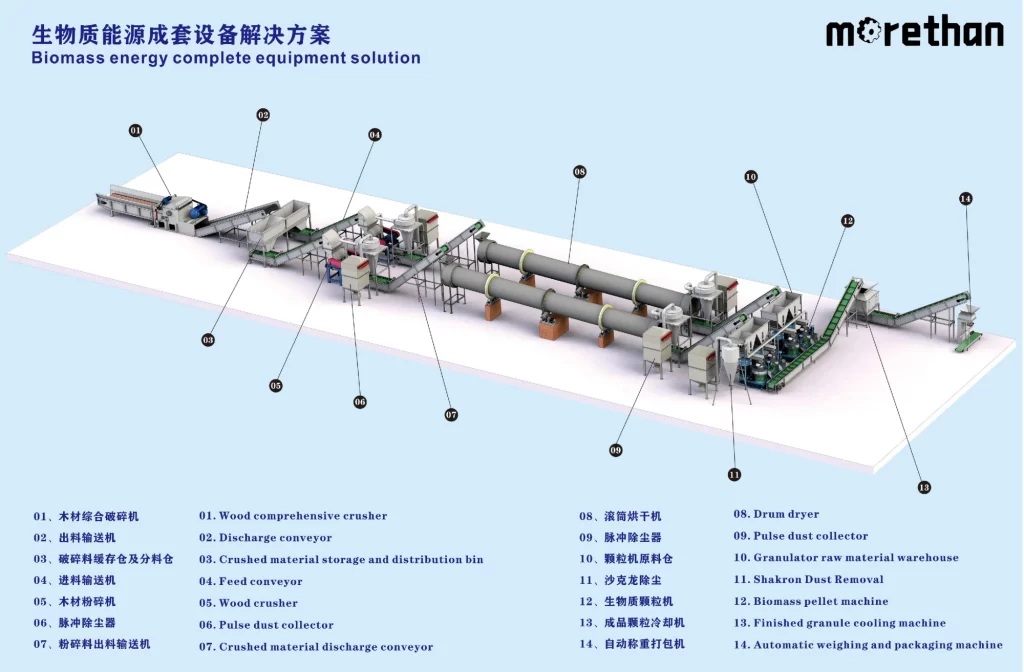
3D layout of a complete wood pellet production line, including crushing, drying, pelletizing, cooling and packaging equipment.
When retrofitting an existing pellet line or executing a new biomass project, the selection of upstream crushing equipment must be synchronized with the rated capacity of the pellet mill and the granulometry requirement of the fine grinding stage. Mismatched crushing capacity or improper chip size will create bottlenecks in the whole production flow. For mobile field projects, the tracked model removes the restriction of fixed workshops and expands application boundaries greatly.
Our technical team evaluates your raw material type, moisture content, hourly output target, site power condition and whether mobility is required to configure a matched crushing module. It can be designed to cooperate with downstream fine milling and pelletizing units, or work independently as a standalone wood waste processing station. Submit your technical specification for engineering layout drawing and formal quotation.
Keywords naturally embedded: Comprehensive Wood Crusher, biomass pellet manufacturing line, pellet mill, water drop hammer mill, lignocellulosic feedstock, size reduction, wood residues, tracked mobile wood crusher
FAQ
Q: What is the functional distinction between a comprehensive wood crusher and a standalone wood chipper?
A: A conventional wood chipper is limited to slicing relatively clean branches into chips. The comprehensive wood crusher adopts compound crushing geometry. It can process irregular, mixed wood waste including nailed pallets and formwork, with higher feeding tolerance. It works as the dedicated upstream size reduction unit for pellet lines, and can be upgraded to tracked mobile type for field crushing.
Q: What is the normal discharge particle range after primary crushing?
A: Standard discharge fraction is 30–50 mm calibrated chips. This fraction is optimized feeding size for water drop hammer mills for secondary fine grinding down to 3–6 mm sawdust. Chips can also be used directly as biomass fuel or carbonization raw material.
Q: How does overload protection work on this crusher?
A: The system monitors main motor current. When load exceeds threshold, the chain feeder pauses or reverses automatically until cavity load falls back to normal setpoint, avoiding stall and mechanical damage.
Q: What are the advantages of the tracked version?
A: Self-propelled tracked chassis adapts to complex terrain. It can travel directly to wood waste sites for on-site crushing, saving transportation cost of bulky raw materials. It is widely used in forestry, green waste disposal and scattered biomass collection projects.
Q: Can the tracked crusher connect with other equipment?
A: Yes, it can be equipped with a discharging conveyor to directly feed materials into the subsequent hammer mill, screening machine or collection bin.